
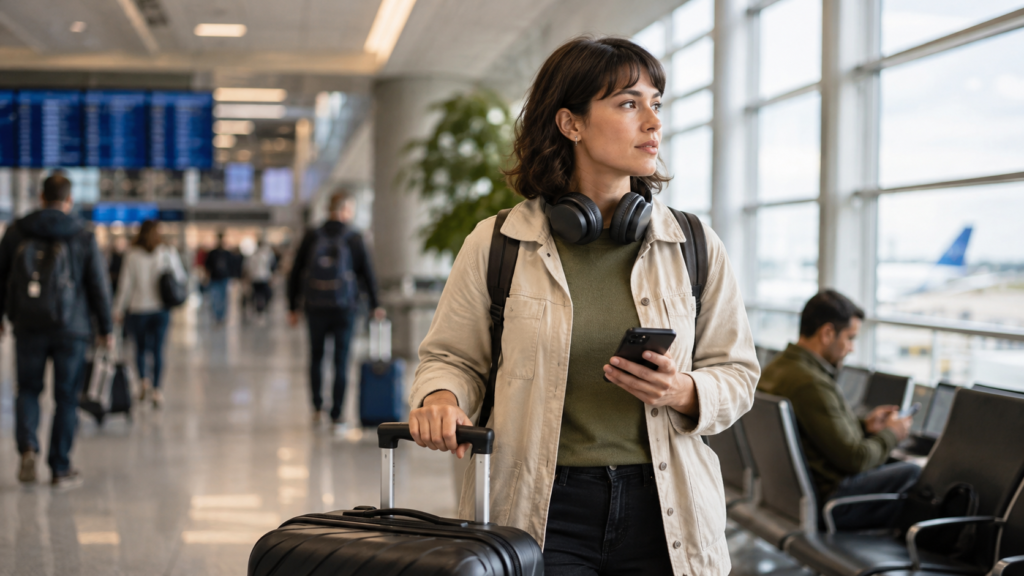
Traveling can mean rest, discovery, fun, and new experiences. ✈️ But it can also involve crowded airports, changes in routine, noise, queues, unexpected events, different foods, unfamiliar environments, and a huge amount of information to process.
When we talk about traveling as an autistic adult, There are needs that often go unnoticed — including by hotels, attractions, and companies that have already begun to look at accessibility for autism.
This happens because a large part of the conversations about autism and tourism It is still aimed at autistic children and their families.
But autistic children grow up.
Adults with autism study, work, form relationships, have children, travel with friends, travel with family, and can also travel alone.
And growing up doesn't mean that sensory needs, difficulties with change, the need for predictability, or other characteristics related to autism simply disappear.
Some autistic people will have minimal support needs during a trip. Others will require assistance or adaptations at different times.
There is no single way to be autistic — and there is also no single way to travel as an autistic person.
🌎 Traveling as an autistic adult begins before leaving home.
For some people, a journey begins when the plane takes off or when the car gets on the road.
For many autistic adults, however, the experience may begin weeks or even months earlier.
Thoroughly researching the hotel, looking at photos of the room, watching videos of the destination, checking the route on a map, finding out where the bathrooms are located, analyzing restaurant menus, and understanding how a particular attraction works can all be part of the preparation.
To an outside observer, this might seem like excessive planning.
But for someone who feels better when they know what to expect, this information helps transform something unknown into a more predictable experience.
Predictability doesn't mean wanting to control absolutely everything.
Often it simply means reducing the amount of new information that needs to be processed at the same time.
1. The need for predictability does not disappear in adulthood.
There is a misconception that, as they grow up, autistic people simply learn to cope with everything that was difficult during childhood.
An adult can indeed develop strategies to cope with changes and unexpected situations. However, this does not mean that these situations cease to generate stress or demand effort.
During a trip, small changes can quickly accumulate:
- The flight changes gates;
- The hotel room is not yet available.;
- An attraction closes unexpectedly;
- The chosen restaurant is full;
- A road is blocked;
- The scheduled tour time has changed;
- The transport is delayed.
For some autistic people, each of these changes requires a significant mental reorganization.
Having a "plan B" can be very helpful.
Saving documents offline, exploring alternative restaurant options, leaving free time in your itinerary, and avoiding extremely tight schedules are simple strategies that can lessen the impact of unexpected events.
2. Sensory fatigue can begin at the airport.
Airports are extremely stimulating environments.
There are announcements on the loudspeakers, suitcases being passed around, people talking, children crying, bright screens, queues, the smells of restaurants, artificial light, and constant movement.
For a person with heightened sensory sensitivity, spending several hours in that environment can require a lot of energy.
And there's an important detail: This effort is not always visible to those around us.
An autistic adult can continue conversing, following instructions, going through security, and finding the gate while using much of their energy to manage environmental stimuli.
Simple resources can make a difference, depending on each person's needs:
- Noise-canceling headphones;
- mufflers;
- sunglasses;
- comfortable clothes;
- self-regulating objects;
- Stay in quieter areas while you wait;
- Avoid peak hours whenever possible.
3. A good trip doesn't need a packed itinerary.
There's a very common pressure during vacations: to make the most of every minute.
After all, flights, accommodation, food, and attractions cost money. That's why many people create itineraries where one activity begins practically as soon as the previous one ends.
Breakfast, sightseeing, lunch, another attraction, dinner, and evening activity.
The next day, it all starts again.
For some autistic adults, this intensity can transform what should be a pleasant experience into a series of overwhelming events.
Returning to the hotel in the middle of the afternoon, staying in the room for a few hours, or simply deciding not to do anything else that day doesn't mean wasting the trip.
Sometimes, rest is precisely what allows you to enjoy the next day. 💜
4. The hotel room is also part of the accessibility.
When we think about accessibility in hotels, it's common to imagine physical adaptations related to mobility.
They are fundamental, but there are other needs that can also make a difference.
For an autistic person sensitive to sounds, for example, sleeping next to the elevator, near the hotel bar, or in a very busy hallway can be quite uncomfortable.
Other factors that may interfere include:
- The air conditioner is very noisy.;
- bright lights;
- Curtains that don't block out the light;
- sounds coming from the street;
- Constant music in common areas;
- Strong smells of cleaning products or air fresheners.
When possible, requesting a room in a quieter area of the hotel can be helpful.
It is also beneficial for hotels to provide clear information and real photos of the rooms and common areas before booking.
The more information the guest has in advance, the lower the level of uncertainty will be upon arrival.
5. The hotel breakfast can be more complex than it seems.
Imagine a room full of people chatting, plates and cutlery clinking, coffee machines, the smell of various foods, people circulating between the tables, and a television playing in the background.
For some people, it's just breakfast.
For others, there are too many stimuli happening simultaneously.
Knowing when traffic is least busy can be a simple and extremely useful piece of information.
Some travelers may prefer to arrive right at the start of the coffee break. Others may feel better closer to the end of the break.
Again: there is no universal rule.
Accessibility begins when there is a possibility of choice.
6. Eating may require planning.
Experiencing the local cuisine is one of the most valued experiences in tourism.
However, some autistic people exhibit selective eating or sensitivities related to the texture, smell, taste, presentation, or temperature of food.
Therefore, researching restaurants beforehand may not just be a matter of preference.
It can be part of the necessary organization for traveling with peace of mind.
Looking at the menu before arriving, finding out if a particular food item is available, and knowing about markets near the hotel can greatly reduce stress.
Depending on the destination and transportation rules, some people also prefer to bring certain known foods for emergency situations.
Selective eating should not be treated simply as "fussiness" or a lack of willingness to try something new.
For some autistic people, eating involves important sensory issues.
7. Communication can become more difficult during an overload.
An autistic person who normally communicates very well may have more difficulty organizing their thoughts, making decisions, or responding quickly when they are tired or overwhelmed.
This can happen precisely at times when quick communication seems most necessary.
For example:
Imagine a flight being cancelled after hours in a noisy airport.
The person needs to figure out where to look for information, understand what the alternatives are, talk to employees, analyze schedules, and make several decisions in a short amount of time.
In these situations, a well-prepared team can make a huge difference.
Some simple actions include:
- to give clear and objective instructions;
- Explain one step at a time;
- Give the person a few seconds to process the information;
- Avoid asking multiple questions at the same time;
- Whenever possible, also provide information in writing.
Accessibility doesn't always depend on a completely new structure.
Often, it starts with how someone is treated.
8. Autonomy doesn't mean doing everything without support.
Another point that is rarely discussed when we talk about autistic adults traveling It's the way we view autonomy.
There's a common idea that a person is only truly independent when they can accomplish everything on their own.
But autonomy and support are not opposites.
An autistic adult can organize a trip alone, buy their tickets, book a hotel, and explore another country without company—and still utilize accessibility resources along the way.
You can ask for help finding a gate.
You can use priority service when you are entitled to it.
You can call someone you trust during an unexpected situation.
You may need a few minutes in a quieter environment before continuing.
None of this negates its autonomy.
Often, it is precisely the right support that allows a person to have more independence.
9. Traveling with others doesn't mean a lack of independence.
Similarly, there are autistic adults who prefer or need to travel accompanied.
An escort can help with organization, orientation, communication, paperwork, itinerary changes, or identifying signs of overload.
That doesn't make that experience any less valuable.
The goal of inclusion should not be to enable all people to perform all tasks without any help.
Inclusion means enabling participation with the necessary support for each person.
10. Not all of an autistic adult's needs are visible.
One of the difficulties related to non-visible disabilities is precisely the fact that other people don't always recognize that someone may need support.
An autistic adult can converse, work, drive, travel, and care for their own family, and still have needs related to their disability.
Appearance does not determine the need for support.
Nor should it be necessary to reach the brink of a crisis for a need to be considered legitimate.
A truly inclusive environment is one that attempts to provide accessibility before a person reaches a point of burnout.
11. Sometimes you need to change the script — and that's okay.
Perhaps the tour is much more crowded than expected.
Perhaps the environment is too noisy.
Perhaps the body is simply saying that it has reached its limit for the day.
In these situations, insisting simply because "we've already paid for the ticket" can turn what could be a good memory into an extremely stressful experience.
An accessible roadmap also needs to allow for changes.
Leaving early, canceling an activity, or swapping a tour for a few hours at the hotel doesn't mean failure.
Respecting your own limits is also part of the journey.
12. Fatigue can continue even after the trip ends.
There is another often overlooked need: rest after the trip.
A trip can be wonderful and, at the same time, extremely tiring.
For several days, a person may be processing new environments, new routines, social interactions, sounds, smells, movements, and decisions.
When you finally get home, there may be a greater need for silence, routine, and rest.
This doesn't necessarily mean the trip was bad.
It's perfectly possible to love an experience and still need to recover from it.
When possible, taking a break before immediately returning to work, studies, or other commitments can be a good strategy.
💜 The tourism industry needs to recognize the autistic adult.
In recent years, various spaces have begun to discuss accessibility for autistic people.
This is important.
However, there is still a tendency to associate autism almost exclusively with childhood.
This is evident in awareness campaigns, in the images used by companies, in informational materials, and even in the way some accessibility services are presented.
But autistic adults travel too.
Some travel with their parents.
Others travel with partners, friends, or children.
Some participate in excursions.
Others prefer to explore a destination completely alone.
Inclusive tourism needs to take all these people into account.
What can hotels and tourist attractions do?
Many accessibility improvements do not require major renovations.
Information, training, and flexibility can already make a big difference to an experience.
Some important measures are:
- Provide real photos of the spaces;
- Explain in advance how the experience works;
- Provide information about environments with excessive noise, bright lights, or other stimuli.;
- to offer clear maps and information on the website;
- train teams on non-visible disabilities;
- to avoid infantilizing autistic adults;
- Allow for breaks or temporary exits whenever possible;
- Please provide information on the times of lowest traffic.;
- to offer quieter spaces whenever the structure allows;
- Ask the person directly how you can help them.
These measures can also benefit the elderly, people with other disabilities, families with young children, and many other visitors.
Checklist for traveling as an autistic adult.
Each person knows their own needs best. Even so, some questions can help during the planning process:
- What will the route to the destination be like?
- Which parts of the trip usually cause me the most stress?
- Does the hotel seem quiet?
- Have I already looked up photos of the places I'm going to visit?
- Does my itinerary include rest periods?
- Are there restaurants with food that I can eat?
- Do I have alternatives if an activity is cancelled?
- Do I need to request any accessibility features in advance?
- Are my reservations and documents available offline?
- Do I have any items with me that help regulate my blood sugar?
- Is there a quiet place near the attractions I plan to visit?
- Can I take a break after I get back home?
The best itinerary isn't necessarily the one that allows you to see the most attractions.
It's the one that makes the trip sustainable and enjoyable for those experiencing it.
Traveling as an autistic adult can also be wonderful.
Talking about accessibility, sensory overload, and the need for support doesn't mean that autistic people don't like to travel.
Quite the opposite.
Traveling can provide independence, new discoveries, contact with different cultures, deepening of interests, rest, fun, and memories that last a lifetime.
The problem begins when inclusion is understood as the obligation to tolerate any environment without demonstrating difficulty.
An accessible tourism experience recognizes that different people may need different paths to enjoy the same destination.
Frequently asked questions about autism and travel.
Can autistic adults travel alone?
Yes. There are autistic adults who travel alone and others who prefer or need to travel accompanied. Because autism is a spectrum, support needs vary greatly among individuals.
Why might traveling be more tiring for an autistic person?
Travel typically involves changes in routine, unfamiliar environments, movement, social interaction, sensory stimuli, and unpredictable situations. For some autistic individuals, processing all of this information can require a great deal of energy.
Do autistic people need to enjoy routine during a trip?
Not necessarily. Autistic people are different from each other. Some have a greater need for predictability, while others cope better with change. Therefore, there is no ideal script that works for everyone.
How can you make traveling more comfortable for an autistic adult?
Advance planning, clear information, rest periods, reduced stimuli when possible, and flexibility in the itinerary can help. Most importantly, however, is respecting the individual needs of the person themselves.
Does an autistic adult need to disclose their diagnosis while traveling?
It is not necessary to disclose the diagnosis to everyone during a trip. When a person wishes to use a specific accessibility service, it may be necessary to check beforehand what procedures are adopted by the company, airport, or attraction.
Inclusion also needs to extend into adulthood.
Autistic children grow up.
They become autistic teenagers and adults who study, work, build relationships, start families, and want to explore the world.
Some of these people will need little support during a trip.
Others will need more support.
Many will have needs that will not be immediately noticed by those around them.
None of these situations makes anyone less deserving of participating.
The more hotels, attractions, restaurants, airports, and tourism professionals understand this reality, the closer we will be to truly inclusive tourism.
Because accessibility shouldn't mean teaching a person how to endure any experience.
Inclusion is about building experiences in which different people can also participate, respecting their needs, their autonomy, and their way of being in the world. 💜
Are you an autistic adult or have you ever traveled with someone who is autistic? What needs during a trip do you think are still poorly understood?
Sharing experiences also helps other people plan smoother trips and helps the tourism sector understand that accessibility goes far beyond what we can see.
📣 Share your inclusion experience!
Have you had a positive accessibility experience at a park, hotel, restaurant, or other location? Your story could help other families plan more inclusive trips.
Send your report and it may appear here on the website, in our section Reviews or General Tips!

Don't miss any tips!
Sign up and receive our inclusive tourism experiences directly to your email.
Want to make tourism more inclusive?
We are open to partnerships with accessible spaces, inclusive inns and projects that value diversity.
Get in touch and let's talk!