
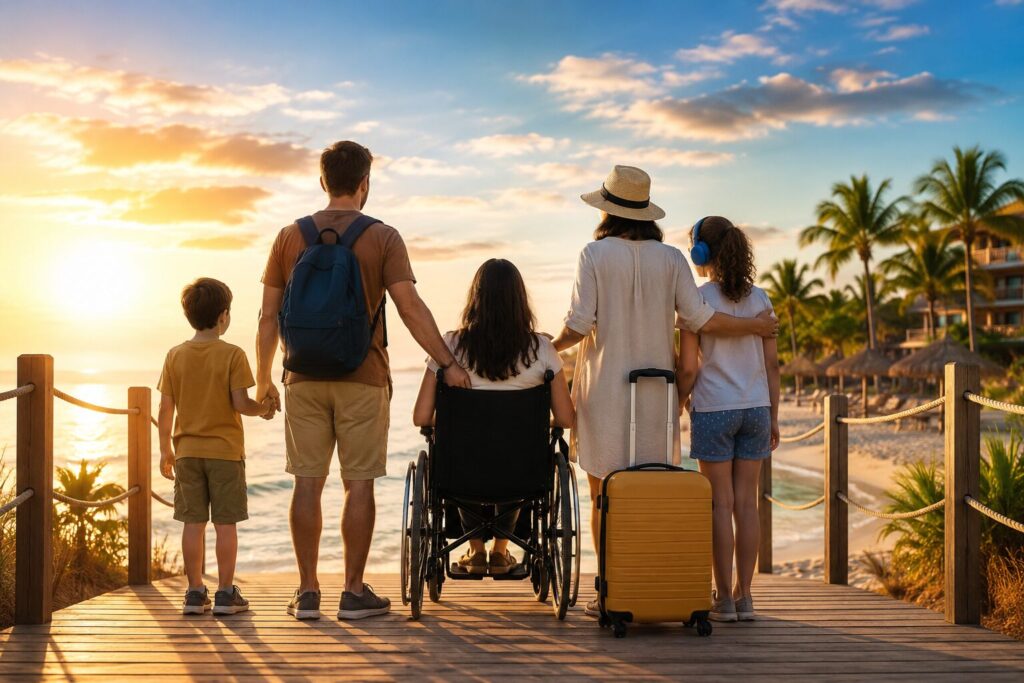
🌍 Inclusion in tourism is not a cost: it's an opportunity, a strategy, and a future.
Many tourism businesses still don't invest in inclusion because they believe in a mistaken idea: that autistic people, people with disabilities, or atypical families don't travel, don't consume, or represent too small an audience to justify adaptations.
But the reality is different.
Atypical families travel. Autistic people travel. People with disabilities travel. Neurodivergent adults travel. Children with sensory needs travel accompanied by their families.
And more than that: many people who currently travel little or have stopped traveling altogether could start traveling again if they found more welcoming, predictable environments prepared to receive them.
Inclusive tourism is not just a matter of social responsibility. It is also a matter of market opportunity.
✈️ Atypical families travel too.
For many families, choosing a hotel, a park, a restaurant, or a tourist attraction involves much more than analyzing price, location, or online reviews.
There's one question that usually comes up before any booking:
“"Will my family be able to enjoy this experience safely, peacefully, and respectfully?"”
When there is an autistic person, a person with a disability, or someone with specific needs, predictability becomes an extremely important factor.
Clear information, prepared service, physical and sensory accessibility, and a welcoming team can make all the difference in the purchase decision.
On the other hand, the absence of these elements can cause an entire family to give up on the experience.
And when a family stops visiting a place, they don't just take one person away. They take with them parents, siblings, grandparents, friends, and all the consumption that would have happened during that visit.
📈 The rise in diagnoses makes inclusion even more relevant.
In recent years, the number of autism diagnoses has increased significantly in several countries.
This doesn't necessarily mean there are more autistic people than before, but rather that there is greater awareness, better diagnostic criteria, and more access to information.
As a result, more families are identifying their needs and seeking environments that offer suitable experiences for all their members.
Furthermore, studies show that autism has a strong genetic and familial influence. This means that it is relatively common for several neurodivergent individuals to exist within the same family, even if they exhibit different characteristics.
In practice, this means that the demand for more accessible and inclusive environments will continue to grow over the next few years.
Companies that start preparing now will be better positioned to serve this audience in the future.
🚀 Inclusion doesn't just attract customers. It creates new travelers.
There is a point that is rarely discussed in the tourism sector.
Many people don't stop traveling because they don't like to travel.
Many times, women don't travel because they've had bad experiences, faced embarrassing situations, or simply haven't found places prepared to receive them.
Families with autistic children often report fear of facing unpredictable queues, extremely noisy environments, lack of understanding from staff, or absence of spaces for sensory regulation.
In many cases, this causes these families to reduce the frequency of their trips or even stop traveling altogether.
When a business demonstrates that it is prepared to welcome different types of visitors, it not only wins over customers from the competition.
It can also encourage people who currently avoid traveling to participate in these experiences again.
In other words, inclusion doesn't just redistribute customers within the tourism market.
She can expand her own market.
Inclusive companies help transform people who previously did not consume tourism into new tourism consumers.
💰 Inclusion doesn't necessarily mean huge investments
Another very common myth is the belief that inclusion requires extremely high investments.
Although some structural adaptations may require greater resources, many improvements are low-cost and have a huge impact on the visitor experience.
Often, the biggest gains come from simple actions:
- ✅ Team training;
- ✅ Clearer communication on the website and social media;
- ✅ Information about queues, capacity, and sensory stimuli;
- ✅ Provision of noise-canceling headphones;
- ✅ Quiet spaces for breaks;
- ✅ Improved signage for the premises;
- ✅ Visual materials explaining what the experience will be like;
- ✅ More welcoming and empathetic service.
In many cases, the biggest investment is not in infrastructure.
It lies in the cultural shift and the willingness to better understand the needs of visitors.
Small adjustments can be enough to make an entire family feel comfortable visiting a place for the first time.
🏨 Those who don't invest in inclusion may miss out on opportunities.
Consumer behavior is changing.
Today, families research reviews, groups, social networks, and communities before deciding where they will travel.
Information about accessibility and inclusion is increasingly present in these decisions.
A hotel that demonstrates preparedness can be chosen even if it is more expensive.
A welcoming restaurant can become a point of reference for atypical families.
A park that provides clear information can be recommended to hundreds of other families.
At the same time, a negative experience also spreads quickly.
Businesses that ignore inclusivity may end up losing customers not because the audience doesn't exist, but because the audience is looking for better alternatives.
🤝 Inclusion builds trust
When a family finds a prepared place, they tend to develop confidence.
And trust generates loyalty.
Families that feel welcomed tend to:
- 💙 Come back more often;
- 💙 Share with friends and family;
- 💙 Share positive experiences on social media;
- 💙 Recommend the place in groups and communities;
- 💙 Choosing the same company again for future trips.
This means that inclusion can generate results far beyond the first sale.
It helps build reputation and long-term relationships.
❤️ Inclusion is respect, but it's also market intelligence.
Talking about inclusion in tourism is not just about talking about empathy.
It's also about talking about strategy.
Companies that understand societal changes are able to adapt faster and better serve their customers.
And society is changing.
More families are seeking information about accessibility.
More people are receiving diagnoses.
More consumers value companies that demonstrate a commitment to diversity and inclusion.
Ignoring this reality means risking being left behind.
On the other hand, investing in inclusion means opening doors to an increasingly larger audience that is more aware of its needs.
🌎 Conclusion
Autistic people travel.
People with disabilities travel.
Unusual families travel.
And many others would like to travel more if they could find more accessible and welcoming experiences.
Therefore, inclusion should not be seen as a cost or an isolated obligation.
It should be seen as an opportunity to improve the experience for all visitors and build a tourism industry that is better prepared for the future.
The question isn't how much it costs to include.
The question is: how much does a business lose by not being inclusive?
💙 Ultimately, inclusion is about respect.
But it is also about vision for the future, competitiveness, and sustainable growth for tourism.
Autistic Around the World
Tourism, accessibility and inclusion for autistic people and their families.
📣 Share your inclusion experience!
Have you had a positive accessibility experience at a park, hotel, restaurant, or other location? Your story could help other families plan more inclusive trips.
Send your report and it may appear here on the website, in our section Reviews or General Tips!
Don't miss any tips!
Sign up and receive our inclusive tourism experiences directly to your email.
Want to make tourism more inclusive?
We are open to partnerships with accessible spaces, inclusive inns and projects that value diversity.
Get in touch and let's talk!
Great content! Keep up the good work!