Finding a job is still a major challenge for many autistic people in Brazil. And this raises a very common question: Ultimately, are autistic individuals entitled to a job vacancy for people with disabilities? 🧩
The answer is Yes. For all legal purposes, a person with Autism Spectrum Disorder (ASD) is considered a person with a disability. This means that autistic people can apply for jobs reserved for people with disabilities and can also be counted by companies towards compliance with the so-called Quota Law.
But there is an important difference between having a right recognized by law and finding a job market that is truly prepared for neurodiversity.
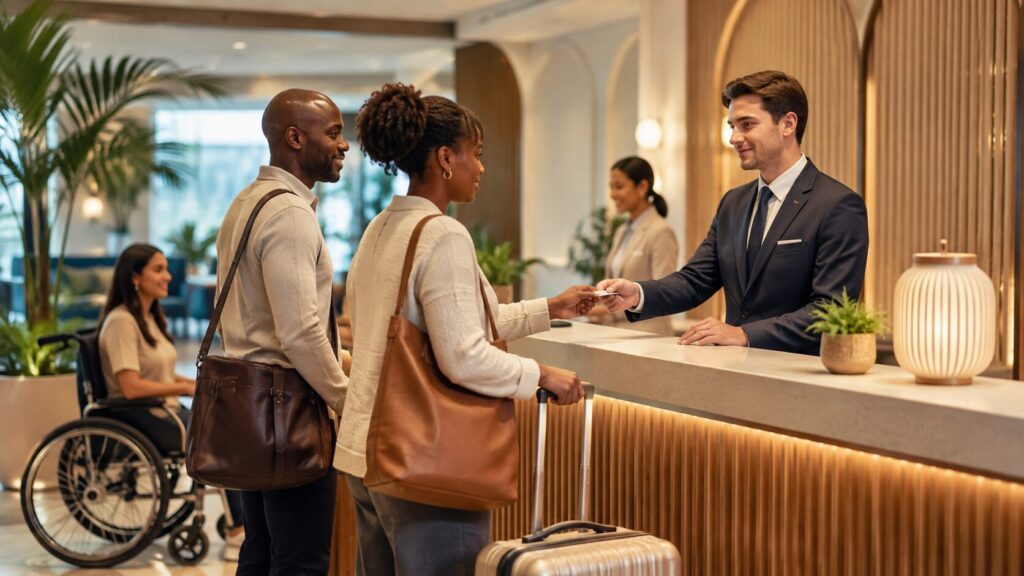
This discussion becomes even more interesting when we look at sectors such as Tourism, hospitality, events, tourist attractions, airports, travel agencies, and traveler services.. ✈️🏨
Ultimately, we're talking about a sector that needs to learn more and more about how to welcome autistic tourists, but which can also make significant progress when it comes to... include autistic people among their own professionals.
🧩 Is an autistic person considered a person with a disability (PCD) under Brazilian law?
Yes. A Law No. 12.764/2012, The law, known as the Berenice Piana Law, establishes that a person with Autism Spectrum Disorder is considered... person with a disability for all legal purposes.
The legislation also includes among its guidelines the encouragement of the inclusion of autistic people in the labor market and recognizes access to work as one of their rights.
In practice, therefore, an autistic person can apply for selection processes intended for people with disabilities, provided that the rules and documentation applicable to each process are observed.
This applies regardless of stereotypes about how an autistic person should look or behave.
The autism spectrum is broad, and different people may have very different needs, abilities, and levels of support.
👉 Official source: Law No. 12.764/2012 – Presidency of the Republic.
⚖️ How does the Quota Law work for people with disabilities?
The call Quota Law This is provided for in Article 93 of Law No. 8.213/1991.
It determines that companies with 100 or more employees fill a portion of their positions with people with disabilities or rehabilitated beneficiaries.
- Companies with up to 200 employees: 2% of the positions;
- 201 to 500 employees: 3%;
- from 501 to 1,000 employees: 4%;
- More than 1,000 employees: 5%.
Since Brazilian law considers autistic individuals to be people with disabilities for all legal purposes, they are eligible for these positions.
However, it is important to understand that the Quota Law It does not automatically guarantee an individual job for every autistic person..
It establishes an obligation to reserve positions for certain companies.
The person participates in the hiring process and must meet the professional requirements compatible with the role, but cannot suffer discrimination due to their disability.
👉 Official source: Law No. 8.213/1991 – Presidency of the Republic.
🤔 If there's a law, why is getting a job still so difficult?
This is perhaps the most important point of the discussion.
In April 2026, the Human Rights Commission of the Federal Senate held a public hearing to discuss precisely the obstacles faced by autistic adults in the job market.
Among the difficulties presented were Prejudice, lack of knowledge about autism, lack of accessibility, and absence of adequate support within companies..
It has also been reported that some autistic people prefer not to disclose their condition when looking for a job for fear of facing prejudice.
During discussions about employability, a widely circulated estimate states that approximately 851% of autistic adults are outside the job market.
This number, however, needs to be treated with caution. Brazil still lacks complete official statistics capable of accurately showing the professional situation of the entire adult autistic population.
What we already know with greater precision is the size of the diagnosed population.
Data released by IBGE based on the 2022 Demographic Census identified 2.4 million people diagnosed with autism in Brazil, approximately 1.2% of the population.
👉 Source: IBGE – 2022 Census and Autism.
🚪 The problem can start even before hiring.
Many traditional selection processes have been built around characteristics that don't necessarily measure a person's ability to perform a given job.
Eye contact, ease in conversing about general topics, fluency in group dynamics, quick answers to unexpected questions, and the ability to demonstrate enthusiasm in a particular way can carry enormous weight during an interview.
For some autistic people, these very situations can represent a challenge.
This does not mean that the person lacks technical knowledge, responsibility, the ability to learn, or the competence to perform the job.
A candidate may, for example, possess excellent knowledge of reservation systems, travel planning, programming, data analysis, photography, administration, or hotel management, and still have difficulties in a traditional group dynamic.
When the company confuses social skills during an interview with professional capacity, Excellent professionals can be eliminated before they even have the opportunity to demonstrate what they can do.
🎧 Workplace accessibility doesn't just mean physical accessibility.
The Brazilian Inclusion Law establishes that people with disabilities have the right to work in An accessible and inclusive environment, with equal opportunities..
The legislation also provides for reasonable accommodations and resources that can promote professional inclusion.
When we think about accessibility, it's common to first imagine ramps, elevators, signage, and adapted bathrooms.
All of this is essential, but there are other forms of accessibility.
For some autistic professionals, small adaptations can make a huge difference:
- ✅ Clearer and more objective work instructions;
- ✅ well-defined routines and responsibilities;
- ✅ Reduce excessive noise or stimuli whenever possible;
- ✅ possibility of using sensory protection features when compatible with the function;
- ✅ Direct communication, avoiding overly ambiguous instructions;
- ✅ Anticipating important changes in routine;
- ✅ More accessible selection processes;
- ✅ Professional evaluation based on actual job performance;
- ✅ Reasonable adaptations as needed for individuals.
This doesn't mean creating a completely different environment for each employee.
It means understanding that Equal opportunities don't always happen by offering exactly the same conditions to everyone..
👉 Official source: Brazilian Inclusion Law – Law No. 13.146/2015.
✈️ And what does all this have to do with tourism?
Very.
When we talk about inclusive tourism, we usually think of autistic people as tourists.
We talked about priority service, stimulus reduction, sensory rooms, trained staff, predictability, maps, accessible airports, prepared hotels, and attractions capable of accommodating different needs.
But there is another question that should also be part of this discussion:
How many autistic people work in these places?
An industry that aims to be truly inclusive should not view autistic people merely as customers who need to receive accommodations.
They can also be professionals.
They can work as receptionists, systems developers, designers, marketing professionals, travel agents, administrative assistants, reservations professionals, analysts, photographers, content producers, researchers, managers, and in countless other tourism-related roles.
🌎 Accessible tourism needs to happen on both sides of the counter.
💡 People with autism can also help the tourism industry to overcome new barriers.
People who experience certain accessibility barriers can offer important perspectives to organizations that want to improve their services.
This does not mean that every autistic person needs to work with accessibility features or that they all have the same characteristics.
But including different experiences within teams can make companies aware of problems that previously went unnoticed.
Imagine a hotel chain developing a service protocol for neurodivergent guests.
Or a tourist attraction rearranging its signs and information to make the visit more predictable.
Or even an airport rethinking everything from passenger arrival to boarding.
Having neurodivergent individuals participating in teams, testing, and decision-making can increase the diversity of perspectives involved in building these experiences.
💬 It's not enough to develop services for autistic people. Whenever possible, it's also important to develop services with their participation.
🏨 Where can autistic people work in the tourism industry?
Another common misconception is imagining that tourism exclusively means working by talking to tourists all day long.
In reality, there is a huge chain of professionals behind each trip.
Some possibilities within or related to the sector include:
- ✈️ travel agencies and tour operators;
- 🏨 Hotels, guesthouses and resorts;
- 🛫 airlines and airports;
- 🎢 parks and tourist attractions;
- 🏛️ museums and cultural centers;
- 💻 Technology and systems development;
- 🎨 Design and user experience;
- 📱 digital marketing;
- 📷 photography and video;
- 📊 Data analysis;
- 🗺️ itinerary planning;
- 🔎 Destination search;
- ♿ Accessibility management;
- 🎟️ Events and production;
- ☎️ Remote support;
- 💳 Reservations and ticketing;
- 🖥️ Management of tourism websites and platforms;
- 📁 Administrative and financial areas.
The choice should take into account each person's skills, interests, experience, training, and needs—not a generalized idea about what autistic people can or cannot do.
🌎 Accessible tourism also involves training professionals.
The Ministry of Tourism has initiatives aimed at promoting accessible tourism, seeking to broaden access to tourism activities for people with disabilities or reduced mobility.
There are also initiatives to train professionals in the sector to improve care for people with Autism Spectrum Disorder.
This movement shows something important:
Accessibility doesn't depend solely on the physical structure of a place.
The behavior, communication, and preparedness of the people who work in that space are also part of the experience.
And that's precisely why there's a direct connection between accessible tourism, professional training and inclusion in the labor market.
The more diverse a team is, the greater the diversity of experiences that can be considered in building that service.
👉 Learn more Accessible Tourism Program.
🚫 Employing an autistic person simply to fulfill a quota is not inclusion.
The hiring is just the beginning.
It's pointless to hire an autistic person simply to fulfill a legal obligation and place them in an environment where no one understands their needs, the leadership is unprepared, and any different behavior is interpreted as a lack of interest or incompetence.
The Brazilian Inclusion Law itself goes beyond simple hiring.
It protects people with disabilities from discrimination during recruitment, selection, hiring, job retention, and career advancement.
In other words, professional inclusion doesn't just mean joining the company.
📈 It means being able to stay, grow, participate in training, receive opportunities, and build a career.
📜 More recent legislation also attempts to facilitate access to employment.
In 2024, it came into effect Law No. 14,992, created specifically to establish measures that promote the inclusion of people with ASD in the job market.
The legislation provides, among other measures, for the integration of information related to autistic people with the National Employment System (Sine), seeking to facilitate the intermediation of job openings and apprenticeship contracts.
It also establishes incentives for initiatives such as job fairs and awareness campaigns for employers to hire people with disabilities.
This is another important step.
But transforming legislation into everyday inclusion still depends on companies, managers, human resources professionals, and society itself.
👉 Official source: Law No. 14.992/2024 – Presidency of the Republic.
🧠 Tourism companies need to look at neurodiversity
Hotels, restaurants, parks, museums, airports, attractions, transportation companies, and agencies are increasingly being held accountable for accessibility.
This is an important step forward.
But perhaps the next step is to understand that inclusion shouldn't exist only in the relationship between company and consumer.
It also needs to exist within the teams.
A company that puts up a priority service symbol at the entrance but can't adapt its selection process for a candidate with a disability still needs to make progress.
A hotel that advertises it is prepared to receive autistic guests, but does not prepare its leadership to work with neurodivergent employees, may also move forward.
A tourist attraction that creates a sensory regulation room for visitors demonstrates an important concern.
And this same logic of understanding different needs can also be part of internal policies aimed at professionals.
🌎 Inclusive tourism begins before the trip and continues far beyond tourist services.
✅ What can a company do to better include autistic professionals?
There is no single adaptation that works for all autistic people.
The first step is to abandon generalizations and listen to the professional themselves.
Some possible measures include:
- Review selection processes;
- train managers and HR teams;
- to make instructions more objective;
- allow for reasonable accommodations;
- analyze potential sensory barriers;
- Create secure channels for communicating needs;
- evaluate performance using objective criteria;
- to offer real opportunities for development and growth.
It is also important that autistic professionals are not treated as incapable of growing within the organization.
The opportunity needs to continue after the hiring.
❤️ Inclusion also transforms the travel experience.
Node Autistics Around the World, We believe that accessibility means enabling different people to participate in society with greater autonomy, respect, and dignity.
When we travel, we want to find destinations that are prepared to welcome autistic people.
We want hotels that understand sensory needs.
We want attractions that offer clear information.
We want more accessible airports.
We want professionals who know how to act in different forms of communication and behavior.
But there is a step before all of that.
We also need organizations willing to work with diversity within their own teams.
A person with autism should not be seen merely as someone who needs to be cared for.
She can answer. 🤝
You can create it. 🎨
You can organize it. 📋
You can develop it. 💻
You can manage it. 📊
You can search. 🔎
You can lead. 🚀
And it can help build a better tourism experience for everyone.
❓ Frequently asked questions about autism and job openings for people with disabilities
Can an autistic person apply for a job with a disability?
Yes. Law No. 12.764/2012 determines that a person with Autism Spectrum Disorder is considered a person with a disability for all legal purposes. Therefore, they can apply for positions designated for people with disabilities, provided they meet the requirements of the selection process.
Does every autistic person have the right to a job?
There is no automatic guarantee of individual hiring. The Quota Law mandates that companies with 100 or more employees reserve 21 to 51 of their positions for people with disabilities or rehabilitated beneficiaries.
Can a company discriminate against an autistic person during an interview?
No. The Brazilian Inclusion Law prohibits discrimination based on disability in the stages of recruitment, selection, hiring, job retention, and career advancement.
Does the company need to adapt the environment for an autistic employee?
Brazilian legislation provides for an accessible and inclusive work environment and the possibility of reasonable accommodations. Needs must be assessed individually, because autistic people can have very different profiles and needs.
Can autistic people work in tourism?
Yes. Autistic people can work in any field compatible with their skills, training, interests, and professional conditions.
The tourism sector involves much more than in-person service and offers opportunities in administration, technology, marketing, reservations, research, hospitality, attractions, planning, content production, and various other areas.
🌟 Inclusion doesn't end when the position is filled.
Brazil already has laws that recognize important rights for autistic people in the job market.
The challenge now is to ensure that these rights are realized in everyday life.
The hiring of autistic professionals should not be seen merely as fulfilling a quota.
It's part of something much bigger: building environments where different people can develop their abilities without having to artificially fit into a single behavioral pattern.
And for tourism, there is an even greater opportunity.
A sector that learns to include autistic people within its teams can also become better prepared to understand and welcome the millions of autistic Brazilians who travel, go for walks, frequent hotels, restaurants, parks, museums, airports, and tourist destinations.
Perhaps this is one of the paths to truly inclusive tourism:
✈️ not only opening doors for autistic tourists, but also opening opportunities for autistic professionals.
📚 Sources consulted: Presidency of the Republic – Law No. 12,764/2012, Law No. 8,213/1991, Brazilian Inclusion Law (Law No. 13,146/2015) and Law No. 14,992/2024; Brazilian Institute of Geography and Statistics (IBGE); Federal Senate; Ministry of Tourism.
📣 Share your inclusion experience!
Have you had a positive accessibility experience at a park, hotel, restaurant, or other location? Your story could help other families plan more inclusive trips.
Send your report and it may appear here on the website, in our section Reviews or General Tips!
Don't miss any tips!
Sign up and receive our inclusive tourism experiences directly to your email.
Want to make tourism more inclusive?
We are open to partnerships with accessible spaces, inclusive inns and projects that value diversity.
Get in touch and let's talk!