
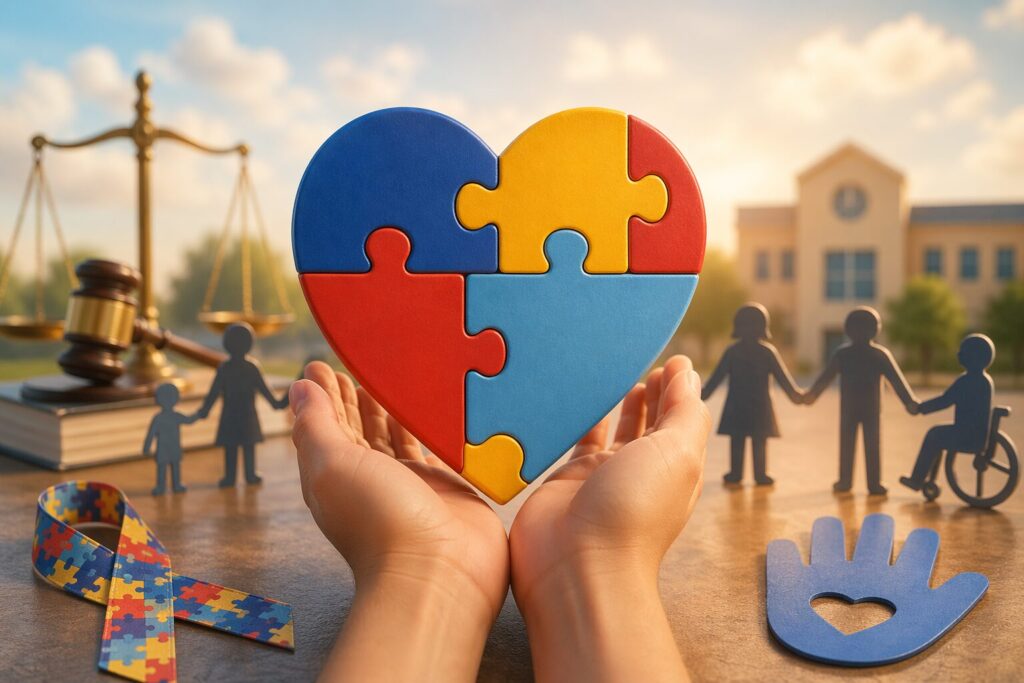
🧩 History of autism in Brazil: evolution of laws, diagnosis and rights
April This is a very important month to talk about autism 💙. In addition to World Autism Awareness Day, celebrated on April 2nd, this period also serves to expand information, combat prejudice, and remember that inclusion doesn't just happen in discourse. Inclusion depends on access to diagnosis, acceptance, public policies, respect, and knowledge of rights already guaranteed by law.
Today, when we talk about autism in Brazil, there is a more structured legal framework than there was a few years ago. We have specific laws, identification documents, care guidelines, and greater social visibility. But this doesn't mean everything is resolved. There are still many challenges related to waiting lists, access to professionals, quality information, school inclusion, and the practical application of rights.
In this article, we will understand How autism gained recognition in Brazil.What laws have shaped this trajectory, how has the topic of diagnosis progressed, and why is it still so important to talk about rights, benefits, and awareness?
📅 Why is April Autism Awareness Month?
The month of April gained momentum because the April 2nd is recognized as the World Autism Awareness DayIn Brazil, this date has also gained prominence in campaigns, educational initiatives, and content focused on inclusion.
In practice, April has become a period when many families begin to seek answers, discover their rights, and better understand autism spectrum disorder. It is also an important month to remember that autism should not be treated with misinformation, stigma, or generalizations.
Accessible information matters a lot 💡. Often, the difference between a more welcoming journey and an experience full of barriers lies precisely in having access to the right knowledge at the right time.
📉 Before specific laws were enacted, autism was poorly understood in Brazil.
For a long time, autism was rarely discussed in Brazilian public policy. Many families faced the search for diagnosis, care, and school adaptation practically alone. There was a lack of clear guidelines, a lack of information, and a lack of more objective legal recognition.
This meant that many autistic people and their families faced a reality marked by invisibility. Even when there was suspicion or a diagnosis, there was not always guidance on what rights could be sought, what paths to follow within the public health system, or how to demand inclusion in practice.
Today, the topic has much more visibility. But understanding this history is important precisely to realize that the advances did not arise from nothing: they were built through mobilization, the fight for rights, and greater social pressure for recognition.
⚖️ The Berenice Piana Law was a watershed moment.
One of the most important milestones in the history of autism in Brazil was the creation of Law No. 12.764/2012, known as Berenice Piana LawShe established the National Policy for the Protection of the Rights of Persons with Autism Spectrum Disorder.
This law represented a very important change because it began to recognize, for legal purposes, a person with ASD as... person with a disabilityThis strengthened access to important guarantees and provided a stronger legal basis for claiming rights in different areas.
Among the most relevant points of the law are guidelines related to:
- ✔️ access to healthcare
- ✔️ Multidisciplinary care
- ✔️ school inclusion
- ✔️ Protection against discrimination
- ✔️ Encouraging the training and development of professionals
It was a real game-changer 🚀. From that point on, autism ceased to be just a topic discussed in isolation and began to have a clearer and more structured legal recognition.
📜 The Statute of Persons with Disabilities reinforced the rights
Another crucial step came with the Brazilian Law on the Inclusion of Persons with Disabilities (Law No. 13,146/2015), also called the Statute of Persons with Disabilities.
Since autistic individuals were already legally recognized as people with disabilities under the Berenice Piana Law, the Brazilian Inclusion Law further reinforced guarantees related to accessibility, inclusion, and social participation.
In practice, this strengthened themes such as:
- ✔️ combating discrimination
- ✔️ Accessibility
- ✔️ inclusive education
- ✔️ equal opportunities
- ✔️ participation in community life
This progress was very important because it helped solidify the idea that inclusion is not a favor. Inclusion is a right 🤝
🪪 CIPTEA brought more visibility and priority.
In 2020, another important development was the creation of Law No. 13.977/2020, which established the CIPTEA, the Identification Card for People with Autism Spectrum Disorder.
The CIPTEA (Brazilian National Identity Card for People with Autism Spectrum Disorder) was created to facilitate the identification of autistic individuals and ensure comprehensive care, prompt assistance, and priority in public and private services. This is especially important because autism is not always a visible disability.
In many everyday contexts, the lack of identification and information from third parties ends up generating embarrassment, unfair judgments, and difficulty in accessing priority care. Therefore, the CIPTEA (Brazilian Identity Card for People with Autism Spectrum Disorder) can make a real difference in the lives of many families.
📊 The inclusion of autism in the census was also an important step forward.
Another important milestone was... Law No. 13.861/2019, which mandated the inclusion of autism-related specificities in demographic censuses.
This may seem far removed from everyday life, but it is very important. More efficient public policies depend on data. When the state knows the population better, it becomes easier to plan actions in health, education, assistance, and inclusion.
Without data, many needs remain unanswered. With more information, the possibility of formulating policies that are more suited to the reality of autistic people and their families increases.
🧠 Diagnosis: Brazil has made progress, but inequality in access persists.
While the issue has gained more visibility, access to diagnosis remains very unequal in Brazil. In some regions, families can more easily access specialized evaluations. In others, the journey is marked by long waiting lists, a lack of professionals, and high costs for private care.
The Ministry of Health itself recognizes the importance of comprehensive care and coordination between different services. (Official publication) Care Pathway for People with Autism Spectrum Disorder (ASD) This reinforces the need for monitoring, qualified evaluation, and organization of the care network.
This is essential because diagnosis should not be treated as something simplistic. It requires listening, clinical observation, developmental analysis, and individualized care. In many cases, the family goes through a long process before getting answers.
Talking about diagnosis, therefore, is also talking about access, acceptance, and regional inequality. Not everyone finds the same gateway to care.
💰 Benefits and rights that are still little known
Even with legal advancements, many families are still unaware of all the rights they may have. Not everything is automatic, and each case needs to be analyzed according to legal criteria. But information makes a big difference along the way.
Among the best-known rights and possibilities, we can mention:
- ✔️ priority service
- ✔️ Access to inclusive education
- ✔️ Protection against discrimination
- ✔️ specific identification documents
- ✔️ possibility of access to welfare benefits, according to the criteria of the law.
An important example is BPC/LOASThis is a welfare benefit aimed at low-income people with disabilities. This benefit is not automatic and depends on an analysis of legal requirements, including social assessment and other criteria. Those who wish to understand more can consult the official government website about it. Disability Assistance Benefit (BPC/LOAS).
This point is very important because sometimes families may have a right to something, but they don't seek it due to a lack of guidance. Clear information remains one of the most powerful tools for inclusion.
⚠️ Why is there still so much misinformation about autism?
Even with more campaigns and more content available, misinformation is still widespread. Part of this happens because many people only come into contact with the topic when they experience a concrete need: suspected diagnosis, learning difficulties, sensory processing disorder, seeking priority access, or questions about their rights.
Furthermore, there are still many frequently repeated myths, such as:
- ❌ “all autistic people are the same”
- ❌ “doesn’t seem autistic”
- ❌ "That's rude"
- ❌ “Autism only appears in childhood”
Autism is a spectrum, and that means diversity 🧩. Each autistic person has different characteristics, needs, sensitivities, and ways of communicating. Reducing this reality to stereotypes only hinders inclusion.
🤝 Inclusion goes far beyond creating laws.
Laws are fundamental, but they alone don't solve everything. Real inclusion happens when rights move from paper to everyday life. This involves acceptance in schools, training for professionals, respect in public and private environments, understanding of sensory needs, and openness to reasonable accommodations.
It also involves listening seriously to autistic people and their families. It's not enough to talk about inclusion without considering real experiences. The lived experiences of those who face queues, judgment, communication barriers, and lack of support need to be taken into account.
When a family needs to "prove too much" something that should already be respected, there's still a long way to go. That's why April should be more than just a month of campaigns: it should be a reminder that awareness needs to turn into practice.
🚀 What has changed — and what still needs improvement
Brazil has evolved considerably when we look at the history of autism in recent decades. We have moved from a scenario of low visibility to a context in which there are already specific laws, formal recognition of rights, greater circulation of information, and instruments such as the CIPTEA (Brazilian National Identity Card for Autism Species).
But there is still much room for improvement, especially in areas such as:
- 📍 Faster access to diagnosis
- 🏥 Reduced queues and improved service
- 🏫 Effective school inclusion
- 📚 More information from society
- 💙 More support for families
The path to inclusion is continuous. And understanding this history helps to appreciate the progress made, while also acknowledging the challenges that still exist.
💙 Conclusion
The history of autism in Brazil shows that rights were won through mobilization, visibility, and collective struggle. Legal recognition has advanced, awareness has grown, and today there is a much stronger basis for demanding inclusion and respect.
At the same time, having nice laws on paper is not enough. It is necessary to guarantee real access to diagnosis, healthcare, education, and humane treatment. It is necessary to combat prejudice, expand access to quality information, and make rights more widely known to those who truly need them.
This April, remembering the evolution of autism in Brazil is also a way to reinforce a commitment: information, respect, and inclusion must exist all year round ✨
📚 Learn more
If you want to continue reading about rights and important documents for autistic people, you should also check out this content here on Autistando pelo Mundo:
👉 CIPTEA in Rio Grande do Sul: how to apply
This type of practical information is very helpful in daily life and can facilitate access to priority care and identification in different contexts.
📣 Share your inclusion experience!
Have you had a positive accessibility experience at a park, hotel, restaurant, or other location? Your story could help other families plan more inclusive trips.
Send your report and it may appear here on the website, in our section Reviews or General Tips!
Don't miss any tips!
Sign up and receive our inclusive tourism experiences directly to your email.
Want to make tourism more inclusive?
We are open to partnerships with accessible spaces, inclusive inns and projects that value diversity.
Get in touch and let's talk!