🍽️ Kids' areas in restaurants: how to make them truly inclusive for autistic children
Going to a restaurant as a family It should be a moment of pleasure. 😌. But for many atypical families, especially those with autistic children, this experience can turn into an anxiety-inducing marathon: excessive noise, bright lights, many people talking at once, noisy toys, and a A kids' space designed solely for "burning off energy.", and not to accommodate different ways of being and playing.
The good news is that A massive reform is not necessary. to make the kids' space more welcoming. With simple adjustments in Layout, sensory stimuli, visual communication, and team posture.Any restaurant can become much more inclusive for autistic children 💛.
🧩 Why does a kids' space need to be inclusive for autistic children?
Children with autism may have:
- Sensory differences – Hypersensitivity or hyposensitivity to sounds, lights, smells, and textures;
- Greater need for predictability Sudden changes and chaotic environments can lead to overload;
- Unique ways of playing and interacting They may prefer to be more isolated, repeat movements, or focus on a specific toy;
- Difficulty with implicit rules – when no one clearly explains what is allowed or not allowed.
When a kids' area doesn't take any of this into account, what should be a support ends up becoming a trigger. The result is usually:
- Overwhelmed child or having a meltdown 😣;
- Parents eating hurriedly, tense, ready to leave;
- families that simply They avoid returning to the place..
On the other hand, one inclusive kids' space:
- It welcomes families with children who have autism, ADHD, and other hidden disabilities;
- It improves the experience of neurotypical children who are more sensitive to stimuli;
- turns into a real differentiator for the restaurant, increasing loyalty and recommendations ⭐.
🔎 Main problems with kids' spaces for autistic children
The problem isn't always a "lack of kids' space," but rather... how it was conceivedSome common points:
- Loud noiseLoud TV, loud music, noisy toys, echo in the environment;
- Bright or flashing lights: spotlights, flashing LEDs, very bright screens;
- Chaotic visualsMany toys piled up, very bright colors, nothing organized into areas;
- OvercrowdingChildren constantly bumping into each other, with no room to back away;
- Confusing or non-existent rulesNo one explains agreements, neither to adults nor to children;
- Absence of a "quiet corner"There is no place for the child to regulate themselves when they are overwhelmed.
For an autistic child, all of this combined can be... too muchAnd the family ends up hearing phrases like:
"But he loves to play, just let him loose in there..."
"That's just how it is, kids make a mess."
In practice, what the family needs is exactly the opposite: Predictability, choices, respect for limits, and a minimally prepared environment..
🛠️ How to make the kids' space more inclusive for autistic children
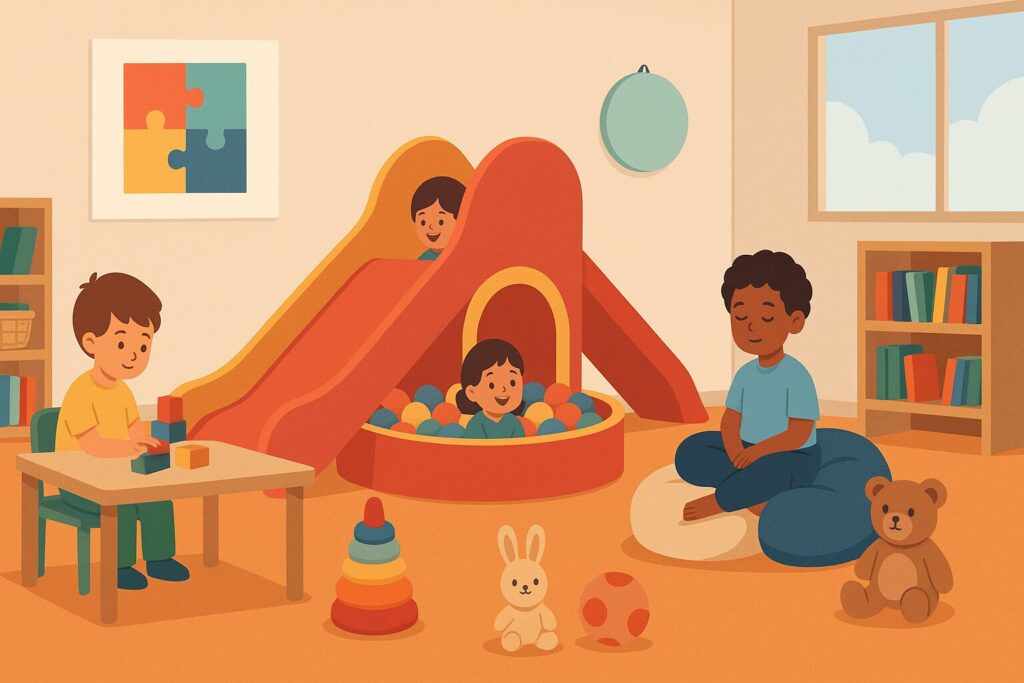
1. Organize the layout: active zones vs. calm zones 🧺
One of the most important steps is separate types of gamesIt doesn't have to be with walls; sometimes, rugs, shelves, or low partitions are enough.
- Active zone:
- slide, ball pit, larger toys;
- Games involving running, climbing, and jumping;
- Ideal for children who enjoy intense activity.
- Quiet area:
- small tables with coloring or building activities;
- books, sensory toys, simple games;
- Soft carpet, cushions, less foot traffic for children.
Visually, this helps the autistic child understand where to go, and allows them to choose the type of stimulus they can tolerate at that moment 💡.
2. Take care of sensory stimuli (sound, light, and smells) 🔊💡
Sensory adjustments are not "frivolous," they are accessibility adaptations.
- Sound:
- Avoid placing speakers directly inside the kids' area;
- Turn down the TV volume – ideally low, with subtitles;
- If possible, use materials that absorb noise (carpets, curtains, panels).
- Light:
- Opt for indirect and stable light – without constant flickering;
- Avoid spotlights pointed directly at children's faces;
- If there are screens, be mindful of the brightness: too high a brightness can also be tiring.
- Smells:
- Avoid strong air fresheners in the kids' area;
- Some autistic children have a strong aversion to sweet or chemical smells.
These adjustments make the space more pleasant not only for autistic people, but for everyone. all children and adults 😉
3. Variety of toys: not everything needs to be "exciting" 🎲
An inclusive kids' area offers More than just toys to jump and run with.It is essential to include structured, calm and sensory play.
Some suggestions:
- Building blocks, large jigsaw puzzles, and interlocking games;
- Books with large images, fabric books, or books with textures;
- Simple pretend play toys (pots and pans, dolls, toy cars);
- Washable drawing and painting materials (always with supervision);
- Sensory toys: soft balls, fidgets, cubes with different textures.
It's not necessary to buy "special products for autism." What makes the difference is... to offer options that aren't just noise and intense movement..
4. Clear visual communication: pictograms and combinations 🖼️
Many autistic children understand much better what is expected of them when the guidelines are... visuals.
You can, for example:
- Place a Simple sign at the entrance from the kids' area with:
- Opening hours ⏰;
- Recommended age range;
- whether a responsible adult must be present or if there is a monitor.
- Use pictograms to:
- "Store toys here" 🧺;
- “Don’t push” ❌;
- “wait your turn” ⏳;
- "Climb the ladder, slide down the slide."
- Create a panel with "Kids' area combos" In simple terms:
- "Playing without hurting friends";
- "Put the toy away when you're finished";
- "Call an adult if something bothers you."
These strategies help both autistic and neurotypical children, as they break the rules. visible, clear and fair.
5. Create a calm or regulating corner 😌
One of the greatest allies of inclusion is quiet corner – a small space inside or next to the kids' area, with fewer stimuli.
A quiet corner can include:
- cushions, poufs or a soft rug;
- A few quiet toys (books, stuffed animals, fidget toys);
- softer lighting;
- less people circulating.
You can signal with something like: "Quiet space" or "A corner to rest"This space is essential for autistic children who are starting to feel overwhelmed and need to "pause" for a while.
6. Train the team to welcome atypical families 🤝
There is no inclusive space without inclusive peopleBasic training may include:
- To explain, in simple terms, what autism is and that it doesn't always "look the same" in all children;
- Avoid making judgments about behaviors such as flapping, echolalia, crying, or isolation;
- To guide the use of welcoming phrases, for example:
- "If you need a quieter place, we can help."
- "If anything here is bothering you, please let us know."
- Recognizing symbols such as the sunflower necklace 🌻 and understand that it is a hidden disability;
- Avoid forcing a conversation with the child – respect their pace and their way of doing things.
For atypical families, being cared for by someone who demonstrates respect and listening It's just as important as the food that arrives at the table.
7. Flexibility and respect: family knows what works 👨👩👧
A restaurant that's friendly to autistic people:
- It allows parents/guardians to remain inside the kids' area, if they prefer;
- It doesn't force the child to use the space – some will prefer to stay at the table;
- It's flexible with table selection: near the wall, further away from the music, with a view of the kids' area;
- It doesn't question whether the family takes it. Headphones with noise reduction, favorite toys, tablet or objects of regulation.
Inclusion is not about "forcing the child to adapt," but rather to open pathways for her to participate within her limitations..
✅ Quick checklist: Is this kids' area inclusive?
You can use this list both as a restaurant manager and as a family evaluating the place:
- 🔊 Is the sound at a bearable level or is it too loud?
- 💡 Is the lighting soft or are there too many flashing lights?
- 🧸 Are there options for calm play (not just slides and balls)?
- 🧩 Is there a quieter spot where the child can rest?
- 📌 Are there any visible rules or agreements in place for the space?
- 👀 Is it possible to see the child from the table, or does the restaurant offer reliable childcare?
- 🤝 Does the team seem open when you talk about autism or specific needs?
The more "yes" answers, the greater the chance that the kids' space will be truly welcoming for autistic children 💛.
🚀 Where to start: practical steps for restaurants
Start today (without spending much)
- Turn down the TV and music volume a bit in the kids' area;
- Organize the toys by areas (active vs. calm);
- Set up a simple corner with cushions and a few quiet toys;
- Create a poster with the rules for the space in simple and friendly language.
In the medium term
- Add some sensory toys and structured games;
- Adjust the lighting to something more comfortable;
- Implement pictograms to guide basic rules;
- Offer a short training session for the team on autism and inclusion.
In the long term
- Plan the kids' area with the support of accessibility professionals;
- Investing in acoustic solutions and even more versatile furniture;
- Create a clear policy for welcoming atypical families;
- To publicize that the restaurant is friend of autistic people – always with responsibility, without promising what cannot be delivered.
💛 Conclusion: Inclusion is about care, not just a fad.
Having a nice kids' area is great for photos. But having a kids' area... truly inclusive It's a gesture of respect that changes the lives of many families.
For autistic children, a prepared environment can be the difference between a lunch filled with tantrums and a pleasant family memory. For restaurants, it's an opportunity to connect with an audience that is often forgotten and that, when they feel welcomed, It returns, recommends, and indicates..
If you're a restaurant manager or owner, know this: small changes can make a world of difference 🌍. If you're a non-traditional family, you're not asking for too much – you're asking for something basic: respect and accessibility.
And if you want more ideas of Inclusive tourism and leisure for autistic people, continue following the Autistics Around the WorldHere we talk about travel, outings, rights, and welcoming – always from the perspective of someone who experiences it firsthand 🧠💙.
📣 Share your inclusion experience!
Have you had a positive accessibility experience at a park, hotel, restaurant, or other location? Your story could help other families plan more inclusive trips.
Send your report and it may appear here on the website, in our section Reviews or General Tips!

Don't miss any tips!
Sign up and receive our inclusive tourism experiences directly to your email.
Want to make tourism more inclusive?
We are open to partnerships with accessible spaces, inclusive inns and projects that value diversity.
Get in touch and let's talk!